Paper Models -Condensing an Idea
Using Paper Models
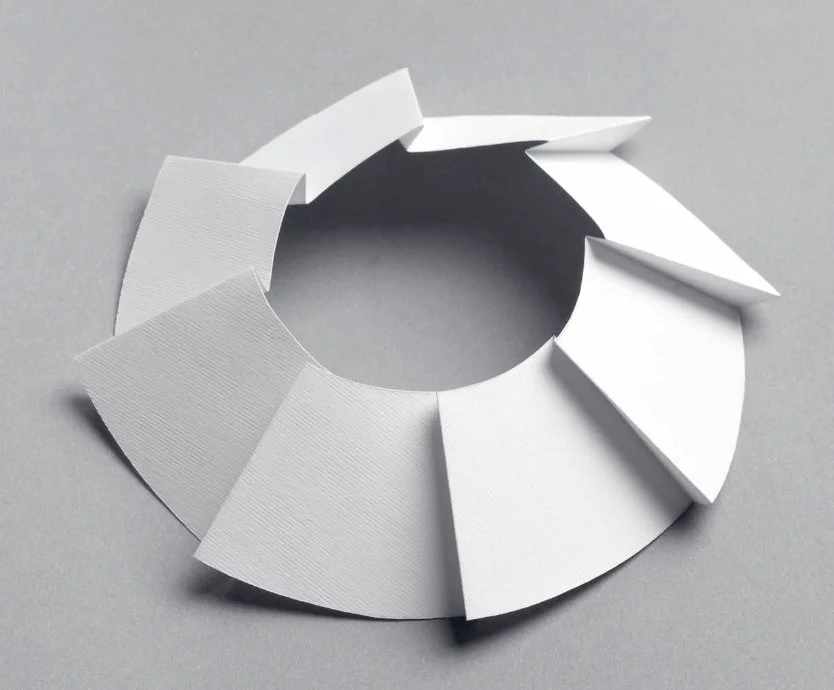
Paul Jackson
a form suggesting jewelry from FOLDING TECHNIQUES FOR DESIGNERS FROM SHEET TO FORM
Paper is a great resource for making three-dimensional models. It can be manipulated in some of the same ways as metal sheet, making it a satisfactory material for design development. Paper, like metal, can be folded, bent, curved, curled, cut, woven, plaited, and joined. What paper lacks in its ability to fully mimic metal it makes up for by its low cost, ease of use, and dimensionality. Many jewelry artists rely on paper and cardboard for preliminary design work to see their ideas from many angles, develop linking mechanisms, and evaluate scale. Incorporating model making in your studio practice has many benefits
We look for an intermediate step between design concept and creation of the piece because moving from an amorphous thought through two physical levels to arrive at a three-dimensional object is a giant leap. Moving from one dimension to the next, as when referencing photos and sketches to make models, can take some practice. Each steppingstone we can find on the path from non-material ideas to a fully dimensional object will ease the process.
Studying origami techniques to learn how to change flat paper into a 3D form is a good start.
Contemporary paper artists take this traditional craft to a higher level; among them is Paul Jackson. Jackson details a series of folds from simple to complex in this pdf download, FOLDING TECHNIQUES FOR DESIGNERS FROM SHEET TO FORM. I am particularly interested in the One Crease series (chapter 7, page 184) since it looks very similar to the effects of fold forming metal sheet. By simply changing the location of the crease, one could arrive at a lovely series of jewelry components.
Paul Jackson’s website features many organic designs that look nothing like traditional origami.
Lavinia Rossetti
paper models are especially useful to develop modular components
Lavinia Rossetti
use paper models to refine scale and linking mechanisms
Lavinia Rossetti is a jewelry artist who uses paper modeling in her design process and teaches the method to others. Many of Rossetti’s designs are composed of modular units. Paper models are particularly suited to this type of exploration. A study of the jewelry on her website will show the benefits of this approach. Shared on her Instagram page are samples from her model-making workshops. The examples show how the model-making process lets students develop details like relationships, connections, and scale. They also show how this process is perfect for designing modular jewelry components.
Artist Maria Lena connecting modular units in Lavinia Rossetti workshop
Jewelry Club crush Chris Carpenter frequently posts the models that precede his jewelry creations. Follow his Instagram page to keep up with his prodigious output and be inspired by his process. Seeing his mind works only enhances our appreciation of his abilities.
Chris Carpenter earrings
Chris Carpenter models
The designs of Mariko Sumioka are composed of elements refined through a series of sketches and paper models. Her work shows the value of creating a solid set of components used repeatedly to produce a unified collection.
Templates are another form of modeling.
Hollow form jewelry starts with a paper template. The template for a hollow form ring is created to accommodate the finger size and gem size in addition to the desired shape of the ring. The benefit of perfecting these details in the template is you will have a pattern to use again. Minor adjustments allow for a range of finger and gem sizes to be made from one good pattern.
Alan Revere shares a concise lesson for making hollow form rings on Ganoksin.
Rings are not the only jewelry item that requires a template. Constructing arcs, cones, cubes, and any jewelry that fits over a curve requires preliminary mapping. Jewelry Club member Valerie Conerway (@topolady on Jewelry Club) hooked us up with a very cool interactive template-making website to advance the process.
Tissue paper sewing patterns are helpful guides when developing designs shaped to a body curve. Dressmaker patterns for collars and cuffs can be used to estimate the amount of material required and the odd shape created when this form is flattened.
Sometimes you get lucky and come across a beautiful form that can be reverse-engineered. On my walk today, I found a beech leaf curled into a spiral cone. Cones are so valuable in jewelry design! By carefully flattening the leaf, I can trace its outline for the start of a pattern to replicate first in paper, then metal.
Make a metal version of the model once you arrive at a design you love or a mechanism that perfectly links things. Barbara Heinrich tells of making brass models of the final version of her intricately joined pieces so she can refer to them when the original jewelry piece is away in a gallery or sold.
If your Notebook Project results in some interesting shapes, use this lesson to guide your research in a direction that best suits your way of thinking and working. And celebrate how, as makers, we have two brains- one in our head and one in our hands. Please share your results, or any other resources you find, on our Jewelry Club Discord (SHOW YOUR WORK #response-to-the-applied-design-topic).
Resources:
Paul Jackson
website, http://www.origami-artist.com/artwork/
FOLDING TECHNIQUES FOR DESIGNERS FROM SHEET TO FORM, http://ommolketab.ir/aaf-lib/kxakxnng1aejt12jxlc0snq20fjg5d.pdf
Lavinia Rossetti
series of modular necklaces from workshop students, https://www.instagram.com/p/CbadQRUsBSO/?utm_source=ig_web_copy_link
check her story “modular necklaces”, https://www.instagram.com/laviniarossetti/
website, https://www.laviniarossetti.com/
Chris Carpenter
https://www.instagram.com/chriscarpenter9353/
earrings from model, https://www.instagram.com/p/B16SJ_BC8uy/
Mariko Sumioka
https://www.instagram.com/marikosumioka/
https://www.marikosumioka.com/
Mobilia catalog https://www.instagram.com/p/CbaRKi4rSg3/
Alan Revere
https://www.ganoksin.com/article/hollow-ring-project/
Template maker
https://www.templatemaker.nl/en/
Barbara Heinrich
Barbara Heinrich: Casual Perfection by Ettagale Blauer , https://www.ganoksin.com/article/barbara-heinrich-casual-perfection/
https://barbaraheinrichstudio.com/
Shape as Form 1
Revelations from the Notebook Project
Edit Site Footer
Judy Parady Studio
Decatur, Georgia
USA
judy@judyparady.com